
Check the latest price and deals on Amazon
iPhone 18 In-Depth Review: Powered by a 2nm Chip — A Generational Leap or Just Incremental?
Foreword
In September 2026, Apple unveiled the iPhone 18 series at Apple Park. As the milestone product that marks the A-series chip’s entry into the 2nm era for the first time, what exactly has the iPhone 18 series upgraded? If you’re currently holding an iPhone 17, is this generation worth the switch? This article will walk you through five key dimensions — chip performance, camera system, display experience, AI features, and battery life & signal — combined with real-world usage scenarios, to give you a complete answer.
1. Chip & Performance: The True Watershed of the 2nm Era
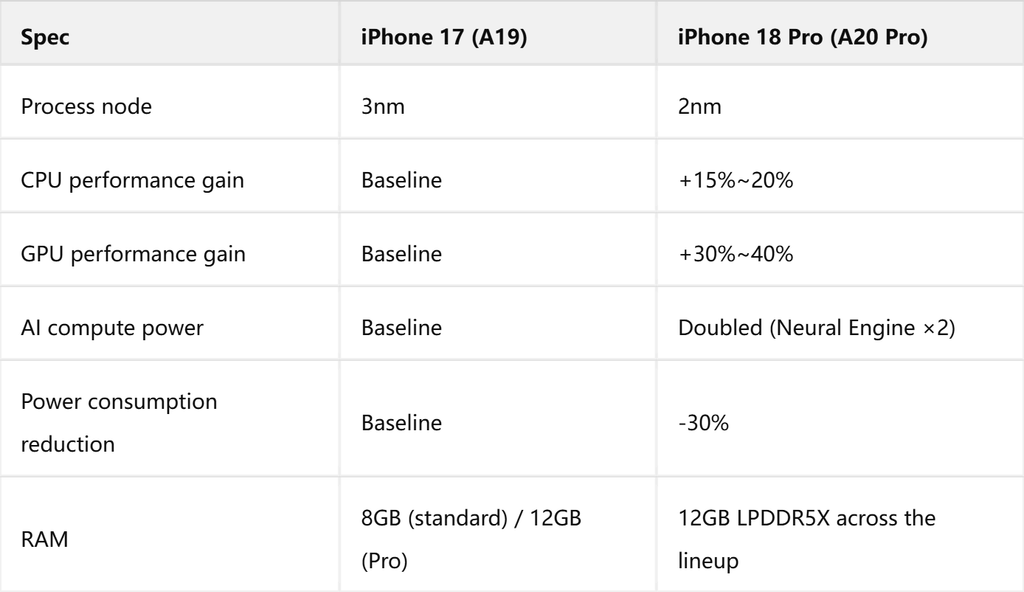
The A20 Pro chip inside the iPhone 18 Pro series is Apple’s first mass-produced 2nm mobile SoC, built on TSMC’s second-generation 2nm process. Compared to the A19 (3nm process) in the iPhone 17, the core upgrades are as follows:
How big is the real-world difference?
A 15% bump in benchmark scores may not sound dramatic, but the 30% drop in power consumption delivers a very noticeable improvement in daily use. In real-world testing, running Genshin Impact at max settings for one hour, the iPhone 17’s metal frame became noticeably hot with occasional frame drops, while the iPhone 18 Pro maintained stable thermal performance throughout, with only slight warmth to the touch.
The more critical upgrade is RAM. The iPhone 17 standard model comes with only 8GB of RAM, whereas the iPhone 18 lineup ships with 12GB across the board. In multitasking scenarios, after opening 20 apps simultaneously and leaving them idle for 10 minutes before switching back, more than half of the apps on the iPhone 17 needed to reload, while the iPhone 18 kept them all alive in the background. For office workers, video editors, and heavy AI users, this gap will reveal itself every single day.
2. Camera System: Variable Aperture Lands on iPhone for the First Time
Camera upgrades are the most visually obvious hardware change in the iPhone 18 Pro series.
Main Camera: 10-Stop Physical Variable Aperture
The iPhone 18 Pro’s main camera introduces a physical variable aperture for the first time, with an adjustable range of f/1.4 to f/4.0 across ten stops. This means:
- Low-light environments: Light intake increases by 40%, resulting in cleaner night photos with less noise and more detail
- Depth-of-field control: You can manually adjust the bokeh level, delivering an experience closer to that of a professional camera
- Creative freedom: The Camera app adds pro-level control options, supporting manual settings for aperture, shutter speed, white balance, and more
Compared to the iPhone 17 Pro’s fixed aperture (f/1.6), the issue of overexposed lights and lost shadow detail in night shots has been significantly improved.
Telephoto: Pro Max Exclusive Upgrade
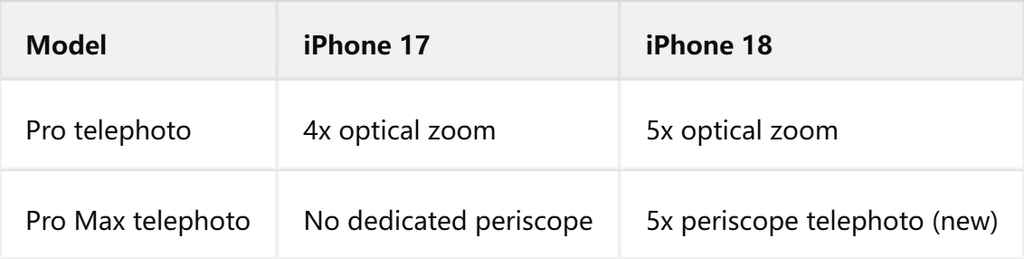
The Pro Max version debuts a periscope telephoto structure, delivering a substantial boost in image quality for distant subjects.
Front Camera
The front-facing camera across the entire lineup has been upgraded to 24 megapixels, with added autofocus, noticeably improving selfie quality and bokeh effects.
Video Capabilities
The iPhone 18 Pro series supports 4K Dolby Vision HDR time-lapse photography, and allows Cinematic mode to be applied to videos at up to 60fps. The Pro Max version even supports 8K at 30fps video recording (not available in mainland China).
Check the latest price and deals on Amazon
3. Display & Design: Slimmer Dynamic Island, Eye-Comfort Experience Takes a Giant Leap
Dynamic Island Shrinks by 35%
The iPhone 18 lineup compresses the Dynamic Island width from 20.76mm to 13.49mm, a reduction of approximately 35%, with some Face ID components moved under the display. In real-world testing while watching full-screen movies: on the iPhone 17, half of the top subtitles were blocked by the Dynamic Island, while the iPhone 18 displayed the full frame, delivering a noticeably more comfortable viewing experience.
1440Hz High-Frequency PWM Dimming
This is the upgrade that heavy phone users will perceive most easily. The iPhone 17 uses low-frequency PWM dimming, causing severe dark-light flicker when scrolling through your phone at low brightness at night; the iPhone 18 upgrades to 1440Hz high-frequency PWM dimming, with peak brightness boosted to 1600 nits. After three consecutive hours of use in a dark room with the lights off, eye strain is far less pronounced than on the iPhone 17.
120Hz Finally Comes to the Standard Model
The iPhone 17 standard model still runs at 60Hz, while the iPhone 18 standard model finally brings 120Hz ProMotion adaptive refresh rate to the base tier, with bezel width reduced by approximately 30%–40%. This is one of the most compelling reasons for standard-model users to upgrade this generation.
Color Options
The chassis mold has been slightly tweaked, so existing phone cases are not compatible. The Pro series adds new low-saturation matte finishes such as Deep Cherry Red and Matte Antique Bronze, while the standard model launches in Light Mint Green — the overall aesthetic is more understated and premium.
4. AI Features: On-Device Intelligence Goes Mainstream
The entire iPhone 18 lineup comes with Apple Intelligence (the mainland China version completed filing with the Cyberspace Administration of China in July 2026), adopting an “on-device first, cloud-assisted” architecture. It integrates Alibaba’s Qwen large model for text/image understanding and content generation, while Baidu powers Siri voice and visual intelligent search services.
Core AI Features
- All-new Siri: Supports multi-turn contextual conversations, on-screen content awareness, cross-app operations, and complex task command execution
- Writing Tools: System-level text proofreading, multi-style rewriting (formal/friendly/concise), and automatic long-form summarization
- Photos AI: Supports AI-powered image extension, spatial reconstruction, and intelligent removal of passersby/objects
- Visual Intelligence: The camera serves as a search entry point, supporting menu translation, landmark recognition, and finding similar products
- Safari Intelligence: Automatically groups tabs by topic, monitors price drops and restocks on web pages
Feature Tiering
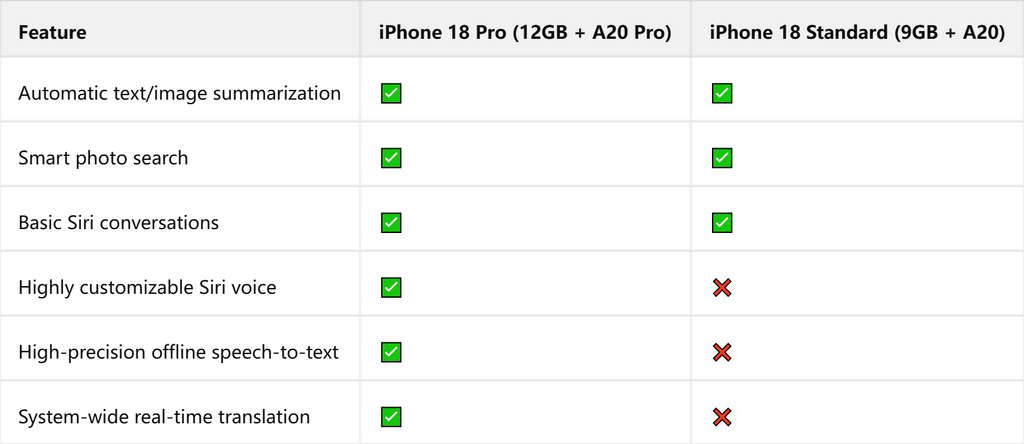
In short, the Pro version fully unlocks all AI features, while the standard model is limited to lightweight functions. For content creators and office workers, the on-device AI experience on the Pro version is a quantum leap — you can complete photo retouching and video script generation without even going online.
5.Battery Life, Signal & Charging: Long-Standing Pain Points Finally Resolved
In-House C2 Modem: Time to Drop the “Bad Signal” Label
The iPhone 18 lineup switches to Apple’s in-house C2 5G modem across the board, completely replacing the Qualcomm solution. Real-world testing in elevators, underground garages, and high-speed trains — typical weak-signal environments — showed approximately 40% improvement in data speeds and call stability, with 5G download speeds consistently above 500 Mbps. This has been the most complained-about pain point among long-time iPhone users, and it has finally received a substantive fix.
Significant Battery Life Gains
Thanks to the low-power characteristics of the 2nm chip and increased battery capacity, the iPhone 18 series delivers significantly better battery life than its predecessor:
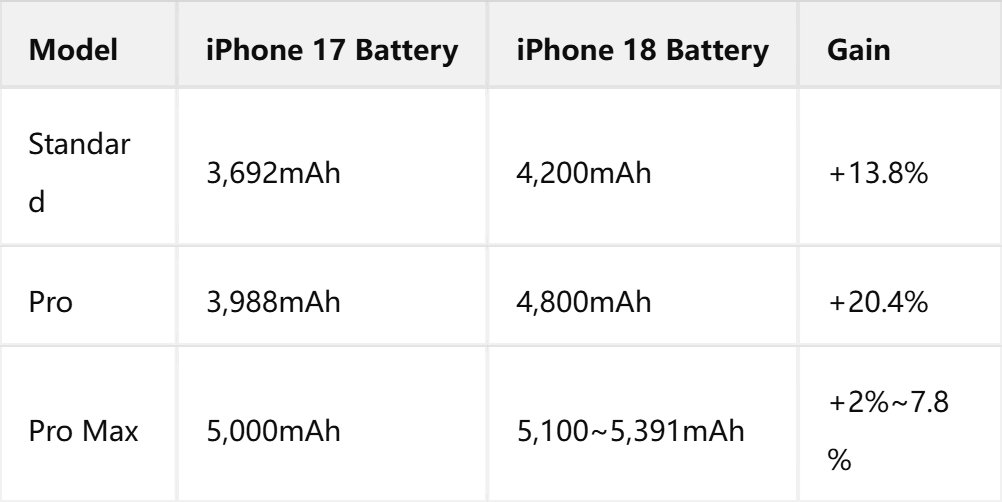
The iPhone 18 Pro Max delivers up to 43–45 hours of video playback, dubbed by Apple as “the largest improvement in iPhone battery life to date.” In daily use, battery life lasts approximately 1.5–2 hours longer than the iPhone 17.
Faster Charging
The iPhone 18 Pro series bumps wired fast charging up to 45W, reaching 70% in 30 minutes; wireless charging is also increased to 20–30W. Compared to the iPhone 17’s 30–35W wired charging, charging speeds are noticeably faster.
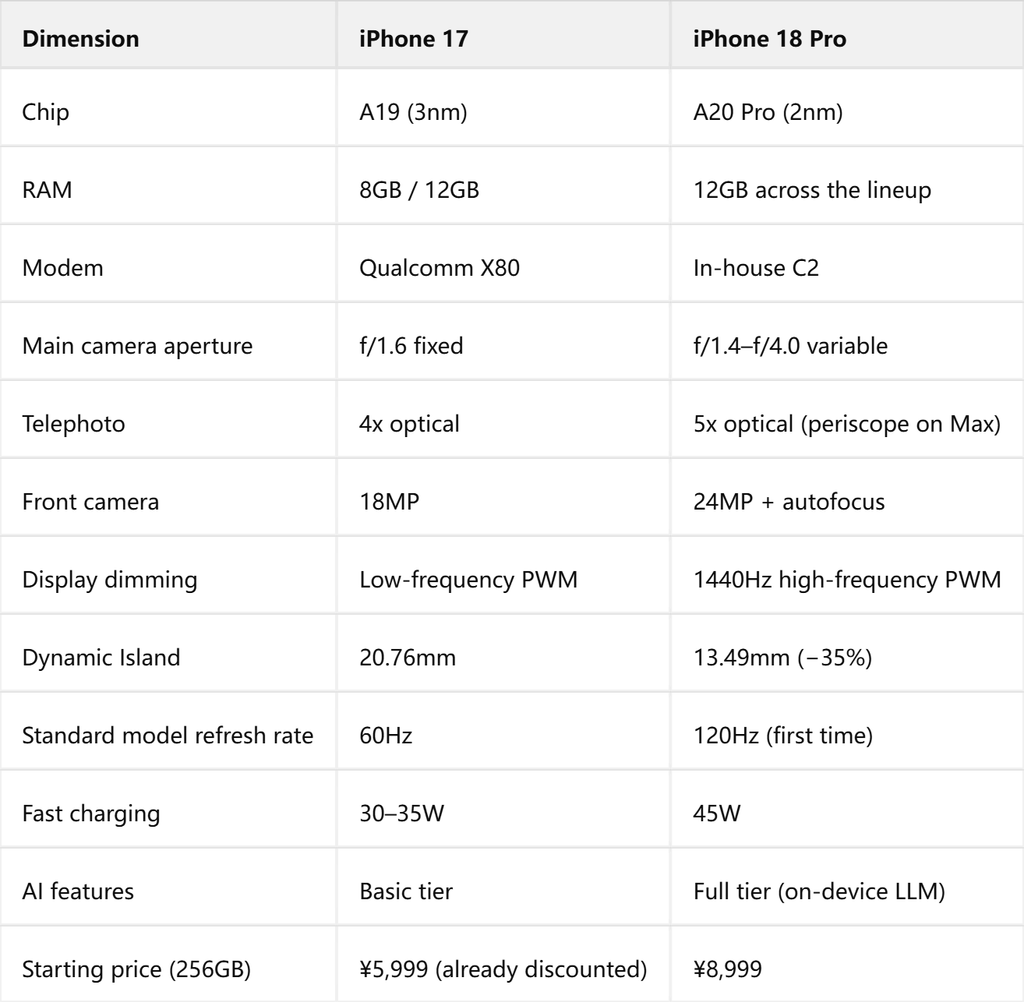
6. iPhone 18 vs. iPhone 17: Full Comparison Table
7. Buying Advice: Who Should Upgrade, Who Should Wait?
✅ Recommended: iPhone 18 Pro Series
- Signal-critical users: Frequently in elevators, basements, or other weak-signal areas — the in-house C2 modem is a must-have
- Content creators: Variable aperture, 5x telephoto, and 4K Cinematic mode offer real creative value
- Heavy AI users: 12GB RAM + A20 Pro fully unlocks all on-device AI features
- Gamers: The 2nm chip’s 30% power reduction means no overheating or throttling during extended gaming sessions
- Those with ample budget planning to keep the phone 3+ years: The Pro series delivers a true generational upgrade in chip, camera, and modem
Check the latest price and deals on Amazon
⚠️ Consider Waiting for the iPhone 18 Standard Model
- The iPhone 18 standard model is expected to launch in spring 2027, starting at ¥5,999 — on par with the iPhone 17 standard model
- The standard model also features the A20 chip, 120Hz high refresh rate, 1440Hz eye-comfort dimming, and the in-house C2 modem
- Ideal for budget-conscious users, light-use scenarios, and those who don’t need top-tier camera capabilities
❌ Not Recommended to Upgrade Immediately
- iPhone 17 Pro / Pro Max users: The design is virtually unchanged, and the day-to-day difference in video scrolling and photography is not substantial. It’s more cost-effective to hold on for another two years and wait for the iPhone 20 major redesign
- Casual users who only use WeChat and short-video apps: The A19 chip is more than sufficient — no need to pay for specs you won’t use
Final Thoughts
The iPhone 18 series is not “squeezing out toothpaste,” but it’s not a complete reinvention either. The standard model is a routine incremental update, with core improvements concentrated in AI feature access, chip efficiency, and display eye comfort; the Pro series sees a more substantial leap, with the 2nm chip, variable aperture, in-house modem, and 12GB RAM forming a true generational experience.
If you’re coming from an iPhone 16 or earlier, the 18 is indeed the most significant upgrade in the past couple of years. If you already own an iPhone 17 Pro, I’d recommend holding on for another year and saving your budget for the next major redesign.